
The complete step-by-step guide for entrepreneurs and startup innovators who want to turn their idea into a real, working product — without wasting time, money, or momentum.
By Pixelerant Technologies · 12 min read · Startup & Founder Series
Quick Answer — The 6 Steps to Turn a Software Idea into a Product
- Validate your problem (not your solution)
- Define your target user clearly
- Map the core user journey
- Scope your MVP — ruthlessly
- Run a Product Discovery workshop
- Build from a blueprint, not a brief
Read on for the full breakdown of each step.
You've been thinking about it for weeks. Maybe months. You have a software idea that could solve a real problem — and you're ready to do something about it.
But when you sit down to actually start, the questions pile up fast. Do I need to learn to code? Should I hire a developer right now? How do I know if my idea is actually worth building? What does an MVP even mean in practice? How much is this going to cost?
If that sounds familiar, you're not alone. Every successful software product — from the apps on your phone to the tools your business runs on — started exactly where you are right now: with an idea and a lot of unanswered questions.
This guide will answer all of them. By the end, you'll know exactly what steps to take, in what order, and why each one matters.
Step 1: Stop Thinking About the Solution — Start With the Problem
Here's the mistake almost every first-time founder makes: they fall in love with their solution before they've truly understood the problem.
You have an idea for an app. Great. But what problem does it solve? For whom? How does that person currently deal with the problem — and why is the current solution not good enough?
The Problem Validation Framework
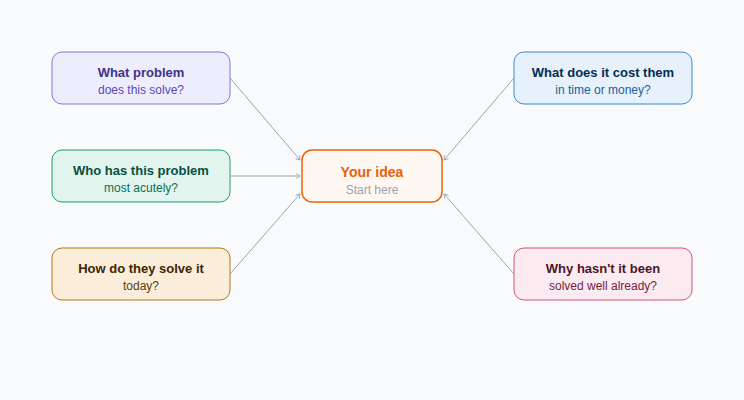
Before you write a single line of code or spend a penny on development, run your idea through these five questions:
- What is the specific problem this solves?
- Who experiences this problem most acutely?
- How are they currently solving it (manually, with another tool, or not at all)?
- What is the cost of the problem — in time, money, or frustration?
- Why hasn't this been solved well already?
Real Talk from Pixelerant: In our Product Canvas Workshops, we run this exercise with every client. You would be surprised how often founders discover, mid-session, that they've been solving a slightly different problem than they thought — or that their real user is not who they assumed. Catching this before the build saves months and thousands.
Step 2: Define Your Target User — Be Ruthlessly Specific
"Everyone" is not a target user. "Small businesses" is not a target user. "People who want to save time" is not a target user.
A target user is a specific person in a specific situation with a specific need. The more precisely you can describe them, the better your product will be designed to serve them — and the more effectively you can market to them.
Build a One-Paragraph User Profile
- Their role or situation (founder, operations manager, freelance designer, parent of school-age children)
- Their primary goal related to your product
- The biggest obstacle between them and that goal right now
- What they currently use to get around that obstacle
- What would make their life significantly better
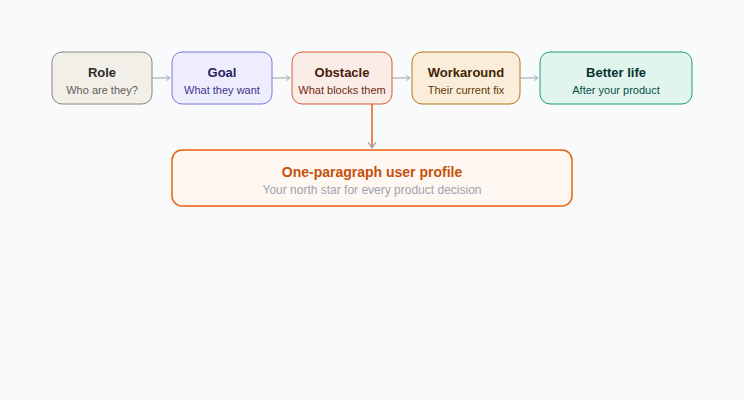
This single paragraph will become one of the most useful documents in your entire product journey.
Step 3: Map the Core User Journey Before You Design Anything
A user journey is the sequence of steps your target user takes to achieve their goal using your product. Most founders jump straight to screens — wireframes, app mockups, UI ideas. But a screen is just a moment in a journey.
How to map a user journey in plain language:
- Write down the starting point — what is your user doing before they open your product?
- Write the ending point — what does success look like?
- Fill in every major step between start and finish.
- At each step, ask: what does the user need to see, do, or decide here?
- Identify the moments where things could go wrong — these are your design priorities.
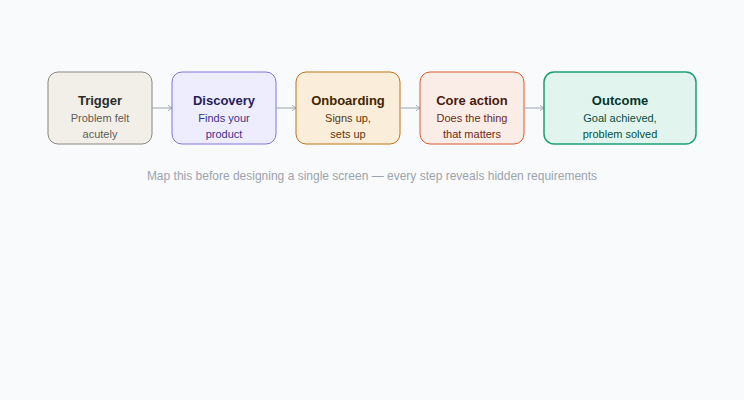
Why this matters for your development budget: Every journey map session at Pixelerant surfaces requirements that were not in the original brief. A 2-hour journey mapping session can prevent weeks of rework.
Step 4: Define Your MVP — Cut Ruthlessly, Then Cut Again
MVP stands for Minimum Viable Product. A product solves one problem for one user in one complete workflow. That is the bar. Everything else is a future version.
The most common MVP mistake: building too much
First-time founders almost always scope their MVP too broadly. The result is a build that takes 12 months, costs three times the initial estimate, and arrives in a market that may have changed.
MVP — Include This:
- The single core workflow that delivers your value
- The minimum data you need to make that workflow function
- Basic user authentication
- One way to complete the key action
- Enough to prove the concept works
Save for Version 2:
- Admin dashboards and reporting
- Social or collaboration features
- Advanced search and filters
- Integrations with other tools
- Mobile app (unless mobile-first is core)
Step 5: Validate Before You Build
Validation is the process of confirming that real people have the problem you think they have — and that your proposed solution is one they would actually use.
Three ways to validate a software idea:
A. Talk to 10 potential users — Have genuine conversations, not pitches. Listen more than you speak.
B. Build a landing page and measure interest — Create a simple one-page website. Add an email signup. The conversion rate tells you more than any focus group.
C. Create a clickable prototype — Use tools like Figma to create a visual prototype of the core workflow — without writing any code.
Step 6: Run a Product Discovery Workshop Before You Hire Anyone
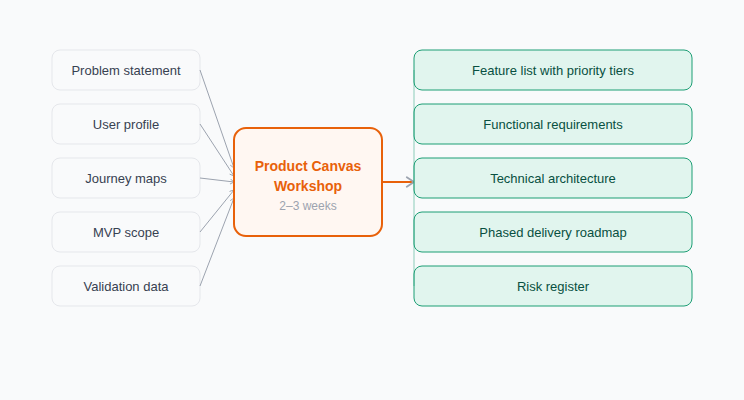
A Product Discovery Workshop takes everything you know about your idea and turns it into a Product Blueprint: a single document that a development team can build from with complete confidence.
What a Product Blueprint gives you:
- A precise scope definition — so you can get accurate quotes from developers
- A feature list with clear priorities — so the build starts with what matters most
- Functional requirements per feature — so nothing gets interpreted differently than you intended
- A technical architecture overview — so you know what you're building before you pay for it
- A phased delivery roadmap — so you can plan your investment in stages
- A risk register — so surprises become expectations
Frequently Asked Questions by First-Time Founders
Do I need to learn to code to build a software product?
No. Your job is to define what to build and why. A development team's job is to figure out how. Focus on clarity, not code.
How much does it cost to build a software product?
A simple MVP can cost anywhere from $15,000 to $100,000+ depending on complexity, geography of your development team, and how clearly defined the scope is.
Should I use no-code tools or custom development?
No-code tools like Bubble, Webflow, and Glide are powerful for early validation. Custom development makes sense when your core workflow requires logic or scale that no-code tools can't support.
How do I find a good software development partner?
Look for a team that asks more questions than they answer in the first conversation. Be wary of any agency that gives you a quote without first understanding what you're building and why.
How long does it take to build an MVP?
A well-scoped MVP with a clear Product Blueprint typically takes 3 to 6 months to build. Projects without clear scope routinely take 9 to 18 months.
Ready to Take Your First Step?
You now have a clear roadmap from idea to working product. If you've validated your problem, defined your user, and you're ready to turn your idea into a buildable specification — the Pixelerant Product Canvas Workshop is designed exactly for this moment.
Book a Free 30-Minute Discovery Call — No obligation. No sales pitch. Just a genuine conversation about your idea and whether we're the right partner to help you build it.